
AI in Healthcare Data Science: A Q&A on What’s Next with Faculty Director Imran Khan

AI in healthcare is changing how organizations use data to make smarter, faster decisions. Adoption is moving quickly, with 85% of healthcare leaders saying their organizations are exploring or already using generative AI capabilities in their work.
To learn how AI is influencing the future of health analytics and what professional opportunities it may create in the field, we spoke with Imran Khan, faculty director of the MS in Healthcare Data Science program at Northwestern University School of Professional Studies (SPS).
In addition to more than 15 years of teaching at Northwestern University, Khan brings extensive industry experience at the intersection of healthcare, research, drug development, data science, digital health, and artificial intelligence. In his professional role, he leads data, digital health, and AI strategy initiatives at a global biopharmaceutical company, where his work supports research and development, medical affairs, value and evidence, and clinical research.
His work has focused on using data, analytics, and emerging technologies to improve how healthcare and life sciences organizations generate evidence, make decisions, and ultimately improve outcomes for patients.
How is AI Transforming Healthcare Analytics Today?
The entire field is being disrupted in very positive ways. When I think about the end-to-end data journey, it starts with understanding the business and the scientific or research questions an organization wants to answer. AI in healthcare, both predictive and generative, is transforming nearly every step of that process. It can help:
- Determine what data is needed
- Organize and clean data
- Accelerate model development
- Generate visualizations
- Tell stories with the data
For example, generative AI has become very powerful for coding and programming, while also helping researchers quickly search published biomedical literature, extract key findings, and summarize information.
In areas like clinical research and drug development, AI can rapidly identify and synthesize information on safety and efficacy endpoints, compare mechanisms of action, and even generate first drafts of study protocols and statistical analysis plans. But while AI can generate strong first drafts, clinical decision-making still requires expert human review.
How AI Is Improving Healthcare Data Preparation and Accessibility?
One of the most remarkable impacts is on data preparation. In healthcare data science, data cleaning has traditionally taken hours, days, or even weeks. In my own experience, AI-enabled approaches have allowed teams to automate roughly 70% of the data-cleaning work in certain use cases, freeing people to focus on outliers, more complex cases, and validating the output.
We're also seeing AI make healthcare data analytics more accessible. Low-code and no-code tools enable physicians, nurses, and pharmacists—not just programmers—to build applications, analyze data, and answer research questions.
Ultimately, AI helps organizations generate insights faster so they can make better decisions, whether that's improving treatments or creating more personalized care plans for patients.
What are the Opportunities and Risks of AI in Healthcare?
At a macro level, as AI systems become increasingly capable and autonomous, questions about safety, accountability, and governance are growing. We’re also seeing regulatory frameworks such as the European AI Act take a risk-based approach to how AI is developed and used.
As it becomes easier to extract insights and support decision-making, clinicians still need to verify sources and understand where bias may exist.
Bias comes in many different forms. In clinical research, just because a drug works well in one study population doesn't mean you can generalize those results to everyone. For example, in dermatology, an AI model may perform extremely well under certain lighting conditions or on one skin type, but that doesn't mean it will perform equally well across different skin tones, imaging conditions, or cameras.
Many of today’s general-purpose generative AI models remain black boxes to some extent. We understand their general approach, but we don’t have complete transparency into all the data used to train them or everything happening within the models that leads to a particular output.
What’s the Status of AI Risk Management and Oversight in Healthcare?
From a regulatory standpoint, the FDA is taking a risk-based approach to AI. The level of evidence, validation, and oversight needed depends in part on the model’s context of use and how its output will inform next steps.
Using AI to generate hypotheses or automate aspects of research is very different from relying on AI-generated information to support decisions affecting patient safety, scientific evidence or regulatory submissions.
As the potential impact of an AI-supported decision increases, so should the level of oversight, validation, and accountability. There's tremendous opportunity, but in healthcare, human oversight or “humans in the loop” is absolutely essential.
What Healthcare Data Science Skills Will Leaders Need in the Next Five Years?
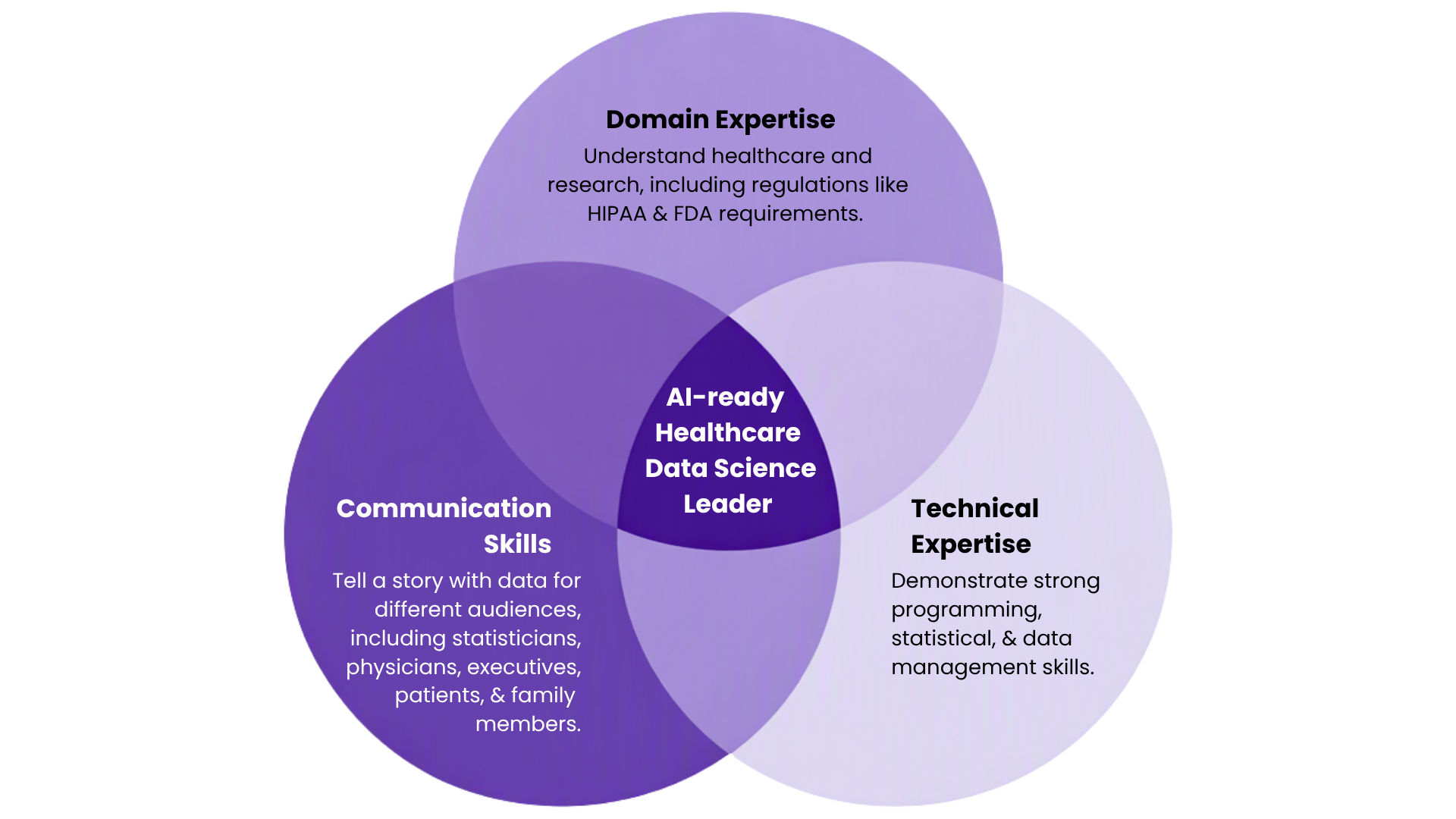
I talk to my students about three circles that every healthcare data science leader needs to be strong in:
- Domain expertise. You need to understand healthcare and research, including regulations like HIPAA and FDA requirements. Managing patient data is very different from managing retail or shopping data.
- Technical expertise. You need strong programming, statistical, and data management skills. AI is making many of these tasks faster, from generating code to summarizing information and extracting insights from large datasets and published research.
- Communication. You must be able to tell a story with data for different audiences, whether you're speaking to statisticians, physicians, executives, or even patients and family members.
How Does AI Impact Foundational Skills for Healthcare Data Science?
For the three circles I just mentioned, what AI changes is the emphasis. It's making programming more accessible, even for non-programmers, so the focus shifts much more toward interpreting results, applying critical thinking, and bringing the human-in-the-loop component.
AI can generate a strong first draft or recommendation, but you still need to determine whether it's the right statistical approach, whether you've selected the right dataset for the patient population or geography, and whether the results make sense.
I compare it to GPS or self-driving cars. AI can help you get where you're going much faster, but if the autopilot fails, you need to know how to take control. That's the expectation. You need enough knowledge of SQL, Python, statistics, and the healthcare domain to validate, debug, and improve what AI produces.
AI is a once-in-a-generation opportunity. We’re looking ahead, and starting to ask questions like, “Can AI help us shorten parts of a drug-development journey that has traditionally taken 10–15 years to perhaps seven or eight years, allowing promising therapies to reach patients faster while maintaining scientific rigor and safety?”
How is the MS in Healthcare Data Science Different from Other Programs?
One of the most common questions I get is, "What's the difference between the MS in Healthcare Data Science and a traditional data science program?"
The biggest difference is that we focus specifically on the healthcare domain. If you're planning to build a career in healthcare, you need to understand how the healthcare system works — not just the technology, but the people and organizations that shape it.
I often talk about the five major stakeholders in healthcare:
- Patients
- Healthcare professionals (including physicians)
- Payers
- Regulatory authorities
- Pharma/research
Most programs focus on patients, payers, and physicians. Those are essential, but we also emphasize regulatory agencies like the U.S. Food and Drug Administration (FDA) and the life sciences industry, including biopharmaceutical and medical device companies.
Although they have different roles, priorities and incentives, all five influence patient care and outcomes. Understanding how they interact in the healthcare ecosystem—from reimbursement and regulation to research and innovation—is a critical part of preparing students for leadership.
How Does the MS in Healthcare Data Science Curriculum Prepare Students for an AI-Driven Future?
A few years ago, the conversation was about whether students should be allowed to use AI at all. Today, we've moved beyond that. Instead of fighting AI, we need to embrace it while recognizing its limitations. That’s why we’re undertaking a major curriculum revision to bring AI to the forefront.
It’s not just a standalone topic or elective. We’re integrating AI throughout the curriculum and the healthcare analytics journey while continuing to build the foundational skills students need to critically evaluate what AI produces. We also offer electives that support different career paths, whether students are interested in healthcare strategy, clinical research, or data science.
Another major differentiator is our capstone experience. Students work on real-world healthcare challenges with industry sponsors, and in some cases their work has even been published in respected biomedical journals.
Like other Northwestern SPS programs, we offer the flexibility of online, asynchronous learning, along with outstanding faculty, guest speakers, and industry connections.
Why Does Human Oversight Matter in AI-Powered Healthcare?
In healthcare, the biggest concern is making sure clinical judgment isn't replaced by AI.
It’s clear that people still need to apply critical thinking, validate results, and make the final decisions. This is especially true in healthcare, where patient safety and ethics are involved.
Our goal is to prepare students for an AI-driven future by combining healthcare expertise, technical skills and the critical thinking needed to use AI responsibly. We expect students to use generative AI tools, but also to validate, question, and improve the results. Ultimately, AI will continue to reshape healthcare analytics, but it's people — not the technology itself — who will determine its impact.
Looking Ahead: Responsible AI in Healthcare Data Science
As AI continues to transform healthcare analytics, organizations will need leaders who can blend technical expertise with critical thinking, ethical judgment, and a deep understanding of the healthcare ecosystem. That responsibility becomes more important when data informs research or decisions that may affect patients.
Faculty director Khan’s perspective shows why responsible AI in healthcare depends on technical expertise and a strong understanding of the healthcare system. AI risk management requires people who can identify bias and consider the context in which a model will be used. Human oversight remains a core piece of that work, even as the technology evolves.
Northwestern's MS in Healthcare Data Science prepares professionals to implement AI responsibly while helping shape the future of data-driven healthcare.
Learn more about the Master’s in Healthcare Data Science program at Northwestern SPS.