
Interview: Naeem Murr on new novel Every Exit Brings You Home
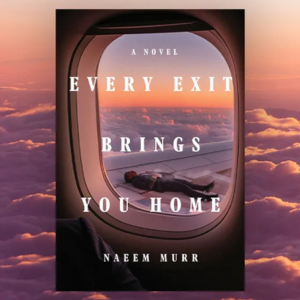
Northwestern SPS sits down with Naeem Murr, award-winning author and Northwestern MFA in Prose and Poetry and MA in Writing faculty member, to discuss his latest novel Every Exit Brings You Home (W.W. Norton, February 2026), a story sparked by witnessing a young family in a U-Haul outside his Chicago building and his reflections on what "home" means for Palestinians. The novel follows Gazan immigrant Jamal "Jack" Shaban, whose past erupts when a troubled neighbor moves into his condominium building.
Murr also shares insights into the importance of sustaining a writing practice and the rewards of working with emerging writers. “It’s inspiring to encounter people willing to take a risk to pursue what they love, and deeply gratifying to help them toward a better understanding of the skills required to bring their vision and voice to life,” he says.
Your new novel, Every Exit Brings You Home, was published by Norton this month. What sparked this story, and what themes or questions are at its core?
Every Exit Brings You Home was prompted nearly five years ago when I took a walk in my Chicago neighborhood one afternoon and noticed a man and woman sitting in an old Chevy Impala hitched to a U-Haul trailer just outside my condominium building. An infant sat asleep in the back. Though the couple were leaning tenderly against each other, they looked bereft—alone. I couldn’t tell if they’d arrived or were about to leave. It felt like the moment after the Biblical Fall.
My paternal family were Palestinian refugees in 1948, and for a while I’d been thinking about what “home” means for a Palestinian. Gaza was also on my mind because it had erupted into the worst violence in years over tensions in East Jerusalem. This prompted the idea for a novel about a Gazan immigrant to Chicago, Jamal (Jack) Shaban, the story catalyzed by a troubled and aggressive single mother moving into Jack’s condominium, her conflicts with others in his building returning Jack to his traumatic past in Gaza, including a taboo affair that nearly cost him his life.
In the novel, the Israeli/Palestinian conflict exists as a broader context of extreme human estrangement, while the condominium serves as a microcosm of the struggle for people to share the same space. Chicago and Gaza are implicitly compared: the violence, the segregation, the old scars of a continuing endeavor to create a just and equitable world. Jack is married to Dimra, a devout Moslem, also from Gaza. Jack, desperate to escape the black hole of his past and his identity, becomes a flight attendant, ever fleeing his life, ever returning, inhabiting alternate selves at work and at home, lying to everyone. Dimra is Palestinian to the bone, obsessed with the Palestinian/Israeli conflict, an abortive immigrant, barely able to leave their apartment. Each trapped in their own ways, they’ve invested all their hope into having an American child.
How do you move forward when your past is too full of love to cauterize, too full of suffering to integrate?
How did the writing and publishing process for this novel differ from your earlier books?
I had a very troubled publishing experience with my previous three novels. With all three books, both in the UK and the US, I lost my editor (the person who bought the book) well before the book was published. Enormous changes in the publishing industry over the last few decades led to a lot of layoffs. This meant that all three of my books were orphaned, with no one at the publishing house having any stake in their success.
I have numerous horror stories that emerged from this situation, but the truth is that many published writers have equally awful stories, and that publishing houses and those who work in them are often caught between a rock and a hard place, having to exist in that liminal space between art and commerce. All any writer has real control over is the quality of their work and the consistency of their production; almost everything else is in the lap of the gods.
Thankfully, my experience with this novel has been very different. I have a wonderful editor at Norton, the only independent publisher of the Big Five. For Norton to publish a book, everyone at the publishing house has to be behind it. They’re clearly doing all they can to give the novel the best chance it has for success.
In what ways does this novel continue or diverge from your previous works?
My novels are very different from one another. The Boy is a literary psychological thriller about a troubled foster child. The Genius of the Sea centers on a mysterious welfare cheat who tells a series of stories that shift from comic and absurd to personal and poignant. The Perfect Man is a coming-of-age story focused on an Anglo-Indian boy abandoned to a small town in Missouri during the ’50s and ’60s. And Every Exit Bring You Home is about a Gazan immigrant to Chicago.
There are certain aspects of my childhood mythos that appear in all my books. I was brought up by a single mother, who kept much of her tragic young life in Ireland a secret. My father died when I was young and most of the fathers of my friends were oppressive or violent. In all my books, mothers (or mother figures) tend to be benevolent but secretive, while fathers are either ghosts or brutes. Jack’s father is a combination of ghost and brute, while his mother, the rock of his life, hides a tragic secret.
I think all my novels, on some level, are about people struggling for a sense of identity. My first two novels are set in England, where I was born and grew up. The Perfect Man is a transitional novel, opening in England, but mostly set in small town Missouri. Every Exit is rooted in America, Jack’s past in Gaza returning only in memory. It marks a further transition also, in that it’s the first novel to emerge out of my Palestinian heritage.
You teach in Northwestern’s MA in Writing and MFA in Prose and Poetry programs. What do you find most rewarding about working with emerging writers?
This program is blessed with non-traditional students from all walks of life. These are people often with broad and unusual experiences. During the wars in Iraq and Afghanistan, for example, a number of veterans came through the program, all of them tremendously talented and dedicated.
In general, it’s a joy to work with students passionate enough to find time to write and attend classes despite their busy schedules. It’s inspiring to encounter people willing to take a risk to pursue what they love, and deeply gratifying to help them toward a better understanding of the skills required to bring their vision and voice to life. It also improves my own writing to teach, engaging me deeply with craft, reminding me that one of the keys to writing well, as Rainer Maria Rilke put it, is to "Resolve to be always beginning—to be a beginner!"
What advice would you offer to writers hoping to publish their first novel?
As I said earlier, what you have control over is the quality of your work. If you write something simply because you think agents or editors might like it, or that it follows some popular trend, you’ll rarely write anything worth reading. What you write needs to matter to you. You need to be engaged emotionally, and you need to feel that your story or novel has a life of its own, one that can push back against your desire to control everything that happens in it.
But first and foremost: learn your craft. That requires a lot of reading (reading as a writer) as well as focused practice. Figure out how you learn best. Does it make sense for you to launch into a long and complex novel, or might it be better for you to start with stories, experimenting with structure, teaching yourself how to develop a character, how to use setting effectively, how to move from single-scene stories into multiple-scene stories that develop over time?
People often think that getting that first book published is the key to success, so it becomes an ultimate goal. But, it’s better to think of your first book as exactly that. The first, hopefully, of many. Often people try to write a first novel that they don’t have the emotional and experiential scope or the technical skill to pull off.
Before I published my first novel, I spent five years writing a vast, speculative novel set in an alternate England. I was deeply engaged in it and no doubt learned a great deal trying to swim its deep and choppy waters. My agent at the time turned it down, leaving me, of course, bereft, believing I had wasted those years. I took a break, travelled to see a social worker friend in the north of England. She told me a story about a troubled foster child. On the train home, the idea for The Boy came to me. That novel was very compact (barely 200 pages long) and it was, if obliquely, expressive of the deeply unhappy year I’d just spent in my childhood home in England. It felt ready to be written and took me less than 6 months to finish.
Writers need to be open to the world. A novel doesn’t come out of your head, it comes out of a complex collaboration between yourself, your experiences, and the world. Books take time to gestate in you, coming to terms well beneath your conscious life. Your responsibility, when something triggers a book’s birth, is to have developed sufficient skill and fortitude to midwife it successfully into the world.
Many students enter the creating writing programs balancing writing with full-time jobs or family responsibilities. What guidance do you give them about sustaining a writing practice long-term?
The first thing is to establish a support network, like a writers’ group, to motivate you and maintain your sense of identity as a writer. If your life allows for it, apply for writers’ residencies. These provide uninterrupted time and can help you grow your network of fellow writers. You can also create a residency for yourself: book a vacation rental, even one in your own city, for a week or long weekend, where you can retreat to be alone and work.
Support from family and friends is also important. Your friends and family must take your writing seriously, honoring your need to have uninterrupted time to write, even if it’s for only an hour a day.
For many writers, this isn’t just about getting work done, it’s about maintaining mental health. If you have young children and a really busy life, then it may make sense for you to work on shorter narratives for a while. Alice Munro, I believe, worked on short stories because her family life was too busy for novels. When you have more time and mental space, you can shift to long stories, novellas, and then to novels. Be constantly working on your craft, tackling your weaknesses as a writer.
And you must have faith in yourself and your work. In Charles D’Ambrosio’s wonderful short story Her Real Name, its aimless protagonist, Jones, recently demobbed from the navy, thinks: “In the navy he’d learned one thing, and for Jones it amounted to a philosophy: there was no real reason to go forward, but enormous penalties were paid by those who refused. He'd learned this lesson rubbing Brasso into his belt buckle and spit shining his boots for inspections that never came.”
This is what faith is. You can conceive of that “inspection” in many ways: God’s grace, luck, opportunity, or the perfect idea for a novel. And, indeed, it may never come. In the story, however, for Jones the “inspection” does come in the form of a young woman dying of cancer, and he is open enough to receive her grace. As a writer, you need to be spit shining your boots every day, always working, learning, improving. In this way, you’ll be prepared when that grace, for which you have fashioned a suitable place, arrives.
Naeem Murr is the author of three previous novels: The Boy, a New York Times Notable Book, The Genius of the Sea, and The Perfect Man, which was awarded The Commonwealth Writersʼ Prize for the Best Book of Europe and South Asia, and was longlisted for the Man Booker Prize. His new novel, Every Exit Brings You Home, was published by W.W. Norton in February 2026. A former Stegner Fellow at Stanford, among his awards are a Pushcart Prize, a Lannan Residency Fellowship, a PEN Beyond Margins Award, and a Guggenheim Fellowship. He lives in Chicago and teaches at Northwestern University
The Every Exit Brings You Home book launch will be held February 26, 2026 at Women & Children First Bookstore in Chicago. Event details and registration are available on the bookstore’s website.
If you’re considering a graduate creative writing program built for working professionals, learn how Northwestern’s MFA in Prose and Poetry and Northwestern's MA in Writing can support long-term creative growth without putting the rest of your life on hold. Fill out the form below and we will be in touch with you soon.